Hiring managers in the US, the UK and Scandinavia often ask us the same question: is the Eastern European talent pool still growing, or is it a story from ten years ago? We answered it with public data only. No surveys from agencies, no vendor rankings: Eurostat, the European Commission, central banks, government ministries and the official results of the International Olympiad in Informatics. This article covers the four countries we hire from: Ukraine, Moldova, Romania and Bulgaria.
The short answer
The pool is large, it keeps growing, and governments in all four countries put real money into it. Bulgaria has added more than 50,000 ICT specialists in ten years. Romania produces ICT graduates at a higher rate than the EU average. Ukraine’s IT exports grew in 2025 while the rest of its service exports fell. Turnover in Moldova’s state technology park has grown about tenfold since 2018. And at the top end, students from Romania and Bulgaria keep winning gold at the world’s hardest programming competition.
How we measured it
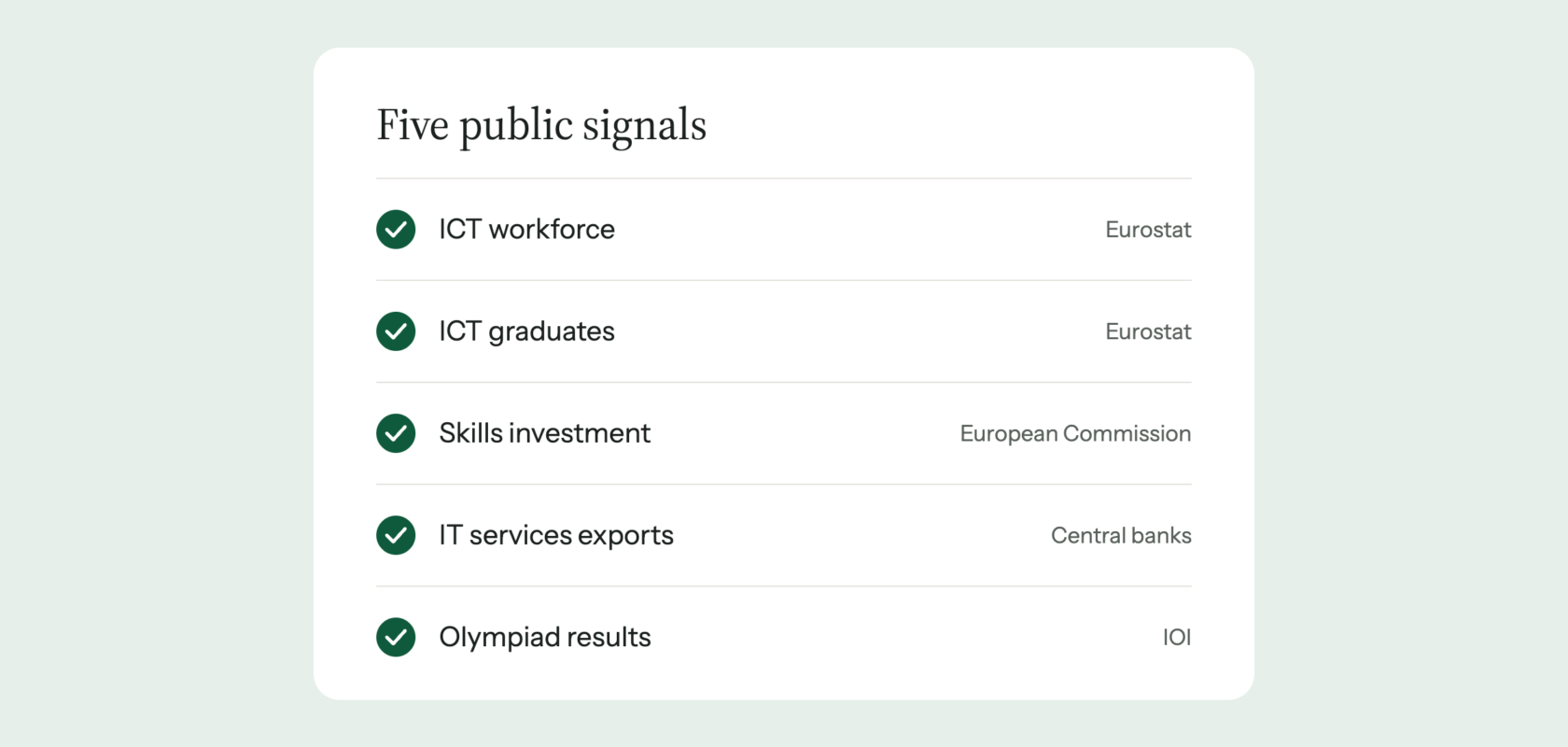
“A strong talent pool” is easy to claim and hard to check. We used five signals that anyone can look up and that are published by public bodies:
- Size and growth of the ICT workforce, from national labour force surveys collected by Eurostat
- The number of new ICT graduates each year, from Eurostat education statistics
- Public investment in digital skills, from the European Commission and national governments
- IT services exports, from central bank balance of payments data, as a sign that the work is good enough for foreign clients
- Results at the International Olympiad in Informatics, as a sign of depth at the very top
Eurostat covers Romania and Bulgaria as EU members. For Ukraine and Moldova we used their central banks, ministries and state agencies.
A workforce that keeps growing
Across the EU, the number of employed ICT specialists rose from 6.56 million in 2015 to 10.45 million in 2025, or 5.0% of all jobs. Bulgaria grew at the same pace from a smaller base: from 88,100 ICT specialists in 2015 to 141,500 in 2025, up 61%, according to Eurostat. Their share of all jobs went from 2.9% to 4.8%, close to the EU level. In its 2026 Digital Decade report, the European Commission calls Bulgaria’s ICT sector “dynamic” and “a strong foundation for digital innovation”.
Romania tells a different story. It has more ICT specialists than Bulgaria, 207,800 in 2025, but they make up only 2.7% of all jobs, the second-lowest share in the EU. The European Commission names talent retention as one of Romania’s main challenges: many engineers it trains end up working for companies abroad. For a team that hires remotely, that is an open door.
| ICT specialists in employment | 2015 | 2025 | Change |
|---|---|---|---|
| Bulgaria | 88,100 | 141,500 | +61% |
| Romania | 160,800 | 207,800 | +29% |
| EU | 6.56 million | 10.45 million | +59% |
Swipe the table to see all columns
One more number stands out. In 2025, women made up 27.8% of ICT specialists in Romania, the highest share in the EU, and 25.0% in Bulgaria. The EU average is 19.5%. A wider pool means a larger shortlist.
Universities that produce engineers
In 2024, Romanian universities graduated 9,077 students in information and communication technologies. That is 7.1% of all tertiary graduates in the country, against 5.0% across the EU. Romania’s ICT graduate numbers have grown by almost a quarter since 2018, and the European Commission lists “a high number of ICT graduates” among the country’s strengths.
Bulgaria graduated 2,281 ICT students in 2024, 4.7% of all graduates, close to the EU average. Ukraine and Moldova are outside Eurostat’s education statistics, but their output shows up clearly in the export and employment numbers below.
Governments that invest in skills
All four countries treat digital skills as a national priority, and the money is visible.
Romania
Romania’s Recovery and Resilience Plan puts EUR 4.5 billion into digital transformation, and another EUR 3.2 billion comes from EU cohesion funds.
Bulgaria
Bulgaria’s plan dedicates EUR 1.2 billion to digital, plus EUR 1.2 billion from cohesion funds. One project alone, Digital skills, has EUR 116 million from the EU and aims at 260,000 certificates in basic and intermediate digital skills by mid-2026.
Ukraine
Ukraine built a special legal and tax regime for tech companies, Diia.City. By November 2025 it had more than 3,000 resident companies employing over 130,000 IT specialists, and the Ministry of Digital Transformation says residents make up more than 80% of the country’s tech sector. Residents had paid about UAH 55 billion in taxes since the launch in 2022.
Moldova
Moldova did the same with the Moldova Innovation Technology Park, a state-created regime for IT companies opened in 2018. It also invested early in school education: in its first year, the Tekwill in Every School programme, backed by the Ministry of Education and international partners, reached 234 schools, 20,000 students and 590 teachers with courses in programming, web development and AI.
Work that foreign clients buy
Exports are the most honest test of quality: foreign companies pay for work only if it meets their standards.
Ukraine exported USD 6.65 billion of computer services in 2025, up 3.3% on the year before, according to National Bank of Ukraine data. In the same year the country’s total service exports fell 7.7%. Computer services now make up 41.6% of everything Ukraine sells abroad as services.
In Moldova, IT services exports passed USD 600 million in the first nine months of 2025, up 23% year on year and more than a quarter of the country’s service exports. Companies in the technology park passed USD 1 billion in turnover in 2025, up 24.3% on 2024 and about ten times the 2018 level. 88.5% of their sales go abroad. The park now has 2,725 resident companies, 571 of which joined in 2025.
Depth at the very top
The International Olympiad in Informatics is the world’s leading programming competition for school students. It is a good proxy for how deep a country’s talent goes, because it measures the same thing everywhere: algorithmic problem solving under time pressure.
According to the olympiad’s official statistics, Romania has won 139 medals over the years and ranks second of all countries by total medals; Bulgaria has 135 and ranks fourth. Ukraine has 110 and Moldova 42. In 2025, in Bolivia, all four members of Romania’s team won gold, the country’s best result ever. Bulgaria took two gold and two silver medals, and Ukraine one silver and three bronze.
Many of these students go on to study computer science and join the same workforce our clients hire from.
Four countries at a glance
Each country is strong in a different way, which is why we hire from all four rather than one.
| Country | Strongest public signal | Latest figure |
|---|---|---|
| Ukraine | IT services exports | USD 6.65 billion in 2025 |
| Moldova | Growth of the IT sector | Tech park turnover +24.3% in 2025 |
| Romania | ICT graduates | 7.1% of all graduates in 2024 |
| Bulgaria | Growth of the ICT workforce | +61% in ten years |
Swipe the table to see all columns
Ukraine has the most mature pool, and the US and the UK are the two largest buyers of its IT services. Moldova is smaller but grows fast, and over 88% of its tech park’s sales already go abroad. Romania brings the strongest university pipeline of the four and the best olympiad record. Bulgaria combines steady workforce growth with one of the highest shares of women in tech in the EU.
Why it matters now
Demand for ICT specialists in Western Europe is not slowing. Eurofound, the EU agency for working conditions, expects the EU to fall about 5 million short of its target of 20 million ICT specialists by 2030. In 2024, 57% of EU companies with IT vacancies struggled to fill them, with the sharpest shortages in senior AI, cloud and cybersecurity roles. Employers are already looking further: the share of ICT specialists from outside the EU rose from 9% in 2021 to 12% in 2024.
For a team in the US, the UK or Scandinavia, Eastern Europe offers what the local market cannot: a large, growing pool with strong technical schooling, one or two hours from Western Europe and with a workable overlap with the US East Coast. We counted the shared hours in Time zone overlap.
What the data does not hide
Ukraine has been at war since 2022. Engineers have relocated, some have been mobilised, and companies have had to plan for power cuts and air raid alerts. IT exports are still below their 2022 record. Yet the sector kept working and kept growing in 2025 while other service exports fell, and most of the industry now operates inside a regime built to keep it stable. Romania and Bulgaria have their own challenges, mainly basic digital skills in the wider population and keeping talent in the country, both named openly in the Commission’s reports. None of these change the picture for hiring experienced engineers. They are reasons to work with people who know the local market.
How to use these signals when you hire
- Look at growth, not only size: a growing ICT workforce means more people moving into Middle and Senior levels each year
- Look at graduates per year: they are the pipeline for the next five years
- Look at exports: they show the share of the workforce already used to foreign clients, processes and English
- Look at the olympiads: they show how deep the top of the pool goes